Our Reggio Emilia inspiration
A little world of
big discoveries.
Every question, idea, and moment of wonder is an opportunity to learn. At Blady’s Little World, we nurture children’s curiosity through meaningful play, relationships, and hands-on exploration.
Reggio Emilia–inspired · Bilingual English & Spanish · Marlborough, MA
Children have so much to share.
Originating in Reggio Emilia, Italy, this educational philosophy sees children as capable learners with ideas worth listening to. Learning grows through relationships, a thoughtful environment, and many ways of expressing and exploring ideas.
We draw inspiration from these values in our family childcare setting, giving children space to explore their interests with caring guidance.
Curiosity leads the way
Children’s questions invite us to investigate together. Educators listen, observe, and offer materials that help their ideas grow.
Many ways to express
Drawing, movement, building, storytelling, and play give children different ways to communicate what they notice and imagine.
Spaces that invite discovery
The environment plays an active role in learning. Thoughtfully arranged materials invite exploration, connection, and new possibilities.
What exploration can look like.
Everyday experiences offer opportunities to create, collaborate, and wonder.
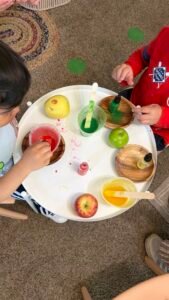
Creating & expressing
Exploring paint and color gives children room to make choices and share ideas in their own way.
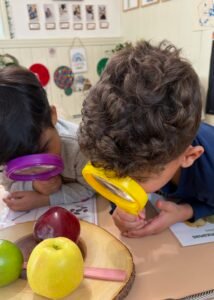
Discovering together
Hands-on experiences invite children to notice textures, try new things, and learn alongside one another.
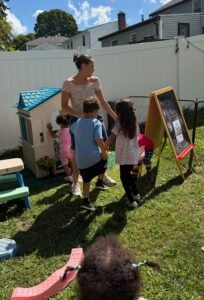
Learning beyond the classroom
Outdoor play opens up opportunities for observation, imaginative play, and shared discoveries.
Families are part of the story.
You know your child in ways no one else does. Your insights, culture, and language help us build meaningful connections between home and our little world.
Learn from Reggio Children.
Visit the official Reggio Children website to explore the origins and values of the Reggio Emilia Approach.
The child
has a hundred
languages
A short excerpt from No way. The hundred is there.
Loris Malaguzzi · English translation by Lella Gandini
A child can share an idea through a drawing, a movement, a story, or something they build. The “hundred languages” reminds us to value these many ways of thinking, expressing, and learning.
Your questions, answered.
We draw inspiration from a philosophy that sees children as capable, curious, and full of ideas. We value their questions, relationships, and many ways of expressing themselves, and adapt these principles to our family childcare setting. “Inspired” describes our approach without implying affiliation with Reggio Children or the municipal schools in Italy.
Children learn by exploring, asking questions, trying ideas, and revisiting what they discover. An educator might notice an interest in building and introduce different materials, invite children to compare structures, or ask what would make a tower more stable. Children are active participants, supported by intentional teaching.
Educators actively guide learning. They observe children’s interests, introduce materials, model language, and ask questions that encourage thinking. They also provide routines, boundaries, and support. Following a child’s curiosity means making thoughtful teaching choices in response to it.
For younger children, exploration begins with movement, sounds, textures, and responsive relationships. Age-appropriate materials and caring interactions give them opportunities to investigate safely. Educators respond to their gestures, sounds, and interests while respecting their individual pace.
Families bring valuable knowledge about their child’s interests, culture, language, and experiences. Sharing what your child enjoys or notices at home helps create connections with their learning here. Your questions and insights are part of the partnership.
Request a tour to meet us, explore our space, and ask about our daily experiences. We’d love to discuss how our program can support your child’s learning and development.
